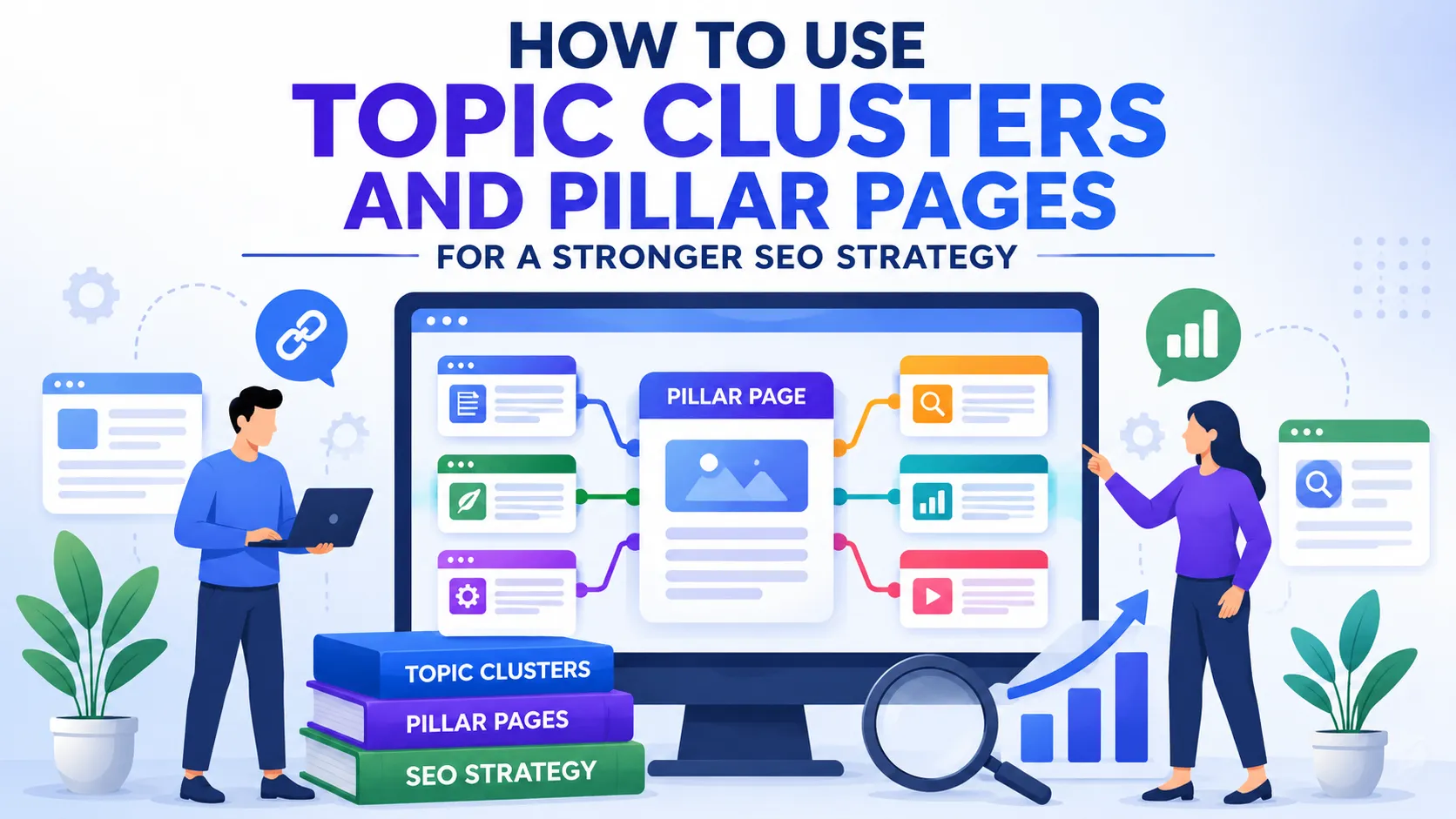
How to Use Topic Clusters and Pillar Pages for a Stronger SEO Strategy
Introduction: Why Topic Clusters and Pillar Pages Matter for SEO
Search engine optimization is no longer simply about inserting keywords into individual articles and building backlinks. Modern SEO requires a comprehensive approach to content organization, search intent, website architecture, and the relationships between different pages. One of the most effective ways to bring these elements together is by using topic clusters and pillar pages.
A topic cluster is a group of related content pieces organized around a central subject. A pillar page serves as the main resource covering that subject broadly, while supporting articles explore individual subtopics in greater detail. Strategic internal links connect these pages, helping users navigate related information and enabling search engines to understand the structure of your website.
For example, a website specializing in digital marketing might create a comprehensive pillar page about search engine optimization. Supporting articles could cover keyword research, technical SEO, on-page optimization, link building, local SEO, and content optimization. Each article addresses a specific search intent while contributing to the broader SEO topic.
When implemented correctly, this structure can help websites build topical relevance, improve content discoverability, reduce keyword cannibalization, and create a better user experience.
In this guide, you will learn how topic clusters and pillar pages work, how to build them step by step, how to implement an effective internal linking strategy, and how to measure their impact on organic search performance.
What Are Topic Clusters in SEO?
Topic clusters are groups of interconnected web pages that collectively cover a broader subject. Instead of publishing isolated blog posts targeting unrelated keywords, a website organizes its content around a clear topical framework.
A typical topic cluster contains three main components:
- A central topic: The broad subject that connects all related content.
- A pillar page: The main resource that introduces the subject and links to supporting articles.
- Cluster content: Individual pages that explore specific questions, subtopics, techniques, or problems related to the central topic.
Internal links connect the pages and establish logical relationships between them.
Example of a Topic Cluster
Consider a website offering professional SEO services. Its topic cluster might look like this:
Central topic: Search Engine Optimization
- Pillar page: The Complete Guide to SEO
- Cluster article: How to Conduct Keyword Research
- Cluster article: Technical SEO Best Practices
- Cluster article: On-Page SEO Optimization
- Cluster article: How to Build High-Quality Backlinks
- Cluster article: Local SEO Strategies for Small Businesses
- Cluster article: How to Optimize Content for Search Intent
- Cluster article: Measuring SEO Performance With Google Search Console
Each supporting article addresses a distinct aspect of SEO while contributing to the overall subject.
This approach creates a more coherent content ecosystem than publishing individual articles without a defined relationship.
Importantly, topic clusters are not a guaranteed ranking factor or a shortcut to higher rankings. Their value comes from helping websites deliver comprehensive, useful information in an organized structure that supports users and search engines.
What Is a Pillar Page?
A pillar page is a comprehensive resource covering a broad topic and connecting readers to more detailed content about its individual aspects.
Unlike a standard blog post that focuses on one specific question, a pillar page provides an overview of an entire subject. It explains the major concepts, introduces important subtopics, and directs readers toward supporting articles when they need more information.
A well-designed pillar page should be informative, easy to navigate, logically structured, and aligned with the search intent of its target audience.
Common Types of Pillar Pages
Different websites can use several types of pillar pages depending on their goals and content strategies.
1. The ultimate guide
An ultimate guide provides a comprehensive introduction to a subject. It is particularly useful for educational topics such as SEO, digital marketing, gardening, web hosting, and software development.
Example: The Complete Guide to Technical SEO.
2. The resource hub
A resource hub organizes valuable resources around a specific topic. It may include tutorials, downloadable materials, tools, case studies, and links to related articles.
Example: The Complete Content Marketing Resource Center.
3. The service pillar page
A service pillar page explains a core service and connects visitors to more specialized service pages, supporting guides, and relevant case studies.
Example: Professional SEO Services for Businesses.
4. The product or category pillar page
E-commerce websites can use category pages to introduce a product category, explain selection criteria, answer common questions, and connect users to useful buying guides.
Example: A Complete Guide to Organic Vegetable Seeds.
The most appropriate format depends on the website’s purpose, audience, and commercial objectives. A pillar page should not be created solely to increase word count or accommodate a large number of internal links.
Topic Clusters vs. Pillar Pages: What Is the Difference?
Although the terms are closely related, they describe different parts of an SEO content strategy.
| Feature | Topic Cluster | Pillar Page |
|---|---|---|
| Definition | A group of related content pages | The central resource covering a broad topic |
| Primary purpose | Organize comprehensive topical coverage | Introduce and explain the main subject |
| Content structure | Multiple supporting articles | One central page |
| Internal linking | Connects related pages across the cluster | Links to relevant supporting content |
| Keyword targeting | Multiple related keywords and search intents | A broad primary topic and its principal intent |
| SEO benefit | Creates coherent topical coverage | Provides a central entry point to the subject |
In simple terms, a pillar page is one component of a topic cluster. The cluster represents the complete content strategy, while the pillar page acts as its central reference point.
Benefits of Using Topic Clusters and Pillar Pages
A well-planned topic cluster strategy can improve several aspects of SEO and content marketing.
1. Building Topical Authority
Topical authority describes the extent to which a website demonstrates relevant, useful coverage of a subject. Although it is not a single publicly defined Google ranking score, comprehensive and reliable topical coverage can help a website satisfy a wider range of related search needs.
Publishing a single article about technical SEO may be useful, but a collection of high-quality resources covering crawling, indexing, XML sitemaps, canonical tags, structured data, and Core Web Vitals provides broader coverage.
Topic clusters help organize this coverage so that individual articles support a clear subject rather than existing as disconnected pieces of content.
The objective is not to publish as many articles as possible. It is to provide the right information for the audience and cover important subtopics at an appropriate level of depth.
2. Improving Internal Linking
Internal links connect pages within the same website. They help users discover relevant information and allow search engines to find pages and understand their relationships.
Topic clusters provide a natural framework for internal linking because the relationship between the pages is established before publication.
For example, an article about keyword research can link to the main SEO guide and to related resources about search intent, keyword mapping, and content optimization.
Likewise, the pillar page can link back to the keyword research article when readers need detailed instructions.
This creates useful pathways through the website and helps search engines discover deeper pages, provided that those pages are accessible and crawlable.
3. Reducing Keyword Cannibalization
Keyword cannibalization occurs when multiple pages target substantially overlapping search intents and compete for similar search visibility.
For example, a website might publish separate articles titled:
- What Is On-Page SEO?
- On-Page SEO Explained
- A Beginner’s Guide to On-Page Search Optimization
- How to Optimize Web Pages for Google
If these pages answer essentially the same questions, they may overlap unnecessarily.
A topic cluster strategy encourages content planning before publication. Each page receives a distinct purpose, primary search intent, and set of related questions.
This does not mean every keyword needs its own page. Closely related keywords can often be targeted naturally within the same article.
Existing overlapping pages may sometimes be consolidated, updated, or differentiated according to their purpose and performance.
4. Increasing Organic Traffic Opportunities
A broad pillar page may target a competitive head term, while supporting articles can address more specific, long-tail queries.
For example, a pillar page about website security may be difficult to rank for a broad keyword. Supporting articles could target more focused searches such as how to configure HTTPS, how to prevent brute-force attacks, or how to secure a WordPress installation.
These articles create additional opportunities to attract users with specific needs.
However, ranking for more keywords is not automatic. Success depends on content quality, competition, search intent, website accessibility, authority, and other relevant factors.
5. Improving User Experience
Visitors rarely follow a perfectly linear journey through a website. Someone reading an introductory guide may need a detailed tutorial, while another visitor may arrive directly at a specialized article from a search engine.
Topic clusters support both journeys by making related resources easy to discover.
Useful contextual links, descriptive headings, a table of contents, and clear navigation help readers move from general information to specific solutions.
A positive user experience also means avoiding unnecessary links, repetitive content, intrusive calls to action, and pages that exist primarily to manipulate search rankings.
6. Supporting Conversions and Business Growth
Topic clusters can support commercial goals by connecting informational content with relevant products and services.
For example, a website offering managed web hosting could create a pillar page about web hosting. Supporting articles might explain hosting types, server security, website performance, domain management, and migration procedures.
Readers who discover the website through informational searches can explore relevant hosting solutions when they are ready.
The important principle is relevance. Internal links and calls to action should match the reader’s needs rather than interrupt the educational experience.
How to Build a Topic Cluster SEO Strategy Step by Step
Creating effective topic clusters requires research, planning, content development, and ongoing optimization.
Step 1: Identify Your Core Topics
Start by identifying the main subjects relevant to your business, website, products, or services.
A useful core topic should meet three conditions:
- It is relevant to your target audience.
- It aligns with your expertise and business objectives.
- It has enough meaningful subtopics to support a connected group of pages.
For an SEO consultancy, potential core topics include keyword research, technical SEO, local SEO, content strategy, link building, and SEO analytics.
For an organic gardening website, core topics could include soil health, composting, vegetable cultivation, pest management, and seed starting.
Avoid selecting topics simply because they have high search volume. Relevance and the ability to satisfy search intent are more important than volume alone.
Step 2: Perform Keyword Research
Once you have identified your core topics, research the keywords and questions people use when searching for information about them.
Useful research sources include:
- Google Search Console for existing impressions, clicks, queries, and page performance.
- Google Keyword Planner for keyword ideas and estimated search demand.
- Search engine results pages for identifying content formats and dominant search intent.
- SEO platforms such as Ahrefs, Semrush, and other keyword research tools.
- Customer questions, support requests, sales conversations, and community discussions.
Organize keywords by intent rather than treating every variation as a separate content opportunity.
For example, the keywords “technical SEO checklist,” “technical SEO audit checklist,” and “technical SEO tasks” may be closely related enough to address in one comprehensive article.
By contrast, “what is technical SEO” and “how to fix crawl errors” may justify different pages because they represent different levels of knowledge and distinct user needs.
Search intent should guide the final decision.
Step 3: Map Keywords to Specific Pages
Keyword mapping determines which page should target each primary search intent.
Create a spreadsheet with columns for:
- Core topic
- Proposed pillar page
- Supporting article
- Primary keyword
- Secondary keywords
- Search intent
- Existing URL, if applicable
- Content status
- Internal linking opportunities
- Performance metrics
This document becomes the foundation of your content cluster.
It also helps prevent duplication by showing which topics already have suitable pages and which require new content.
Before creating a new URL, review existing content. Updating or expanding an established article may be more effective than publishing another page covering the same subject.
Step 4: Design the Pillar Page
Create a pillar page that provides a useful overview of the main subject.
A strong pillar page generally includes:
- A clear introduction explaining the topic and its relevance.
- A logical hierarchy of H2 and H3 headings.
- An explanation of the most important concepts.
- Links to detailed supporting articles.
- Practical examples, illustrations, or original insights.
- Answers to common questions where useful.
- Relevant calls to action, if appropriate.
- A logical next step for readers who want more information.
The ideal length depends on the subject and the needs of the audience. A pillar page should be as comprehensive as necessary without becoming repetitive or difficult to navigate.
A 2,000-word guide that answers the main questions clearly can be more useful than a 6,000-word page filled with unnecessary repetition.
Write for people first and optimize the page naturally for relevant search queries.
Step 5: Create Supporting Cluster Content
Develop supporting articles that address important subtopics in sufficient detail.
Each article should offer independent value and answer a clear question or solve a particular problem.
For a pillar page about technical SEO, supporting content could include:
- How Search Engine Crawling and Indexing Work
- How to Create and Optimize an XML Sitemap
- How to Fix Common Robots.txt Errors
- Canonical Tags Explained for SEO
- How to Improve Core Web Vitals
- Structured Data Implementation Best Practices
- How to Find and Fix Broken Internal Links
These articles should not simply repeat the pillar page. Instead, they should expand on the relevant subject with explanations, examples, instructions, and recommendations.
Prioritize topics based on relevance, audience needs, search opportunity, and the resources available to produce useful content.
You do not need to publish every article simultaneously. A phased content plan is often more manageable.
Step 6: Build a Strategic Internal Linking Structure
Internal linking is one of the most important practical elements of a topic cluster.
Use contextual links to connect supporting articles to the pillar page and to other relevant articles where those connections help readers.
A simple structure might follow this pattern:
Pillar page → Supporting articles → Related supporting articles
The pillar page links to the main cluster resources. Each supporting article links back to the pillar page when appropriate and connects to related content that provides additional value.
For example, an article about XML sitemaps might link to a guide about crawling and indexing. That guide could link to a robots.txt tutorial and a technical SEO checklist.
Not every page must link to every other page. Excessive linking can create clutter and reduce usability.
Use descriptive anchor text that explains what readers can expect after clicking. Phrases such as “how to create an XML sitemap” are usually more informative than repeated generic anchors such as “click here.”
Avoid forcing exact-match keywords into every internal link. Anchor text should read naturally and accurately describe the destination.
Step 7: Optimize Website Architecture and Navigation
Topic clusters should fit into the broader information architecture of your website.
Use logical categories, consistent URL conventions, breadcrumbs where useful, and navigation that reflects how visitors explore your content.
For example, a website might organize its resources under:
/seo/
/seo/technical-seo/
/seo/keyword-research/
/seo/internal-linking/
These are illustrative URL structures, not mandatory formats. Flat or nested URL structures can both work when pages are accessible and logically organized.
Avoid changing existing URLs without a clear reason. Unnecessary URL changes can create redirect requirements and introduce avoidable SEO risks.
Make sure important pages are not isolated from the rest of the website and that internal links point to the intended canonical URLs.
Step 8: Optimize for Search Intent and Content Quality
A technically correct cluster will not perform well if its content fails to answer the questions users actually have.
Review the search results for the target queries to understand whether users expect a definition, tutorial, comparison, product page, checklist, or other content format.
Then create content that satisfies the underlying need while adding original value.
Useful improvements may include:
- First-hand experience and practical examples.
- Original research, data, or case studies.
- Clear explanations of complex concepts.
- Current recommendations and accurate technical details.
- Screenshots, diagrams, or other relevant visuals.
- Answers to important follow-up questions.
- Expert review for specialized or high-impact topics.
Avoid producing multiple near-identical articles simply to target slight keyword variations. Comprehensive, differentiated content is generally a stronger long-term investment.
Step 9: Audit and Update Existing Content
Many websites already have the beginnings of topic clusters without a deliberate strategy.
Review existing URLs and group them by subject. Identify relevant pages that lack internal links, articles that overlap, and important subtopics that remain uncovered.
Possible actions include:
- Improving articles that contain outdated information.
- Adding relevant internal links.
- Consolidating pages that serve the same search intent.
- Expanding thin articles where additional detail is genuinely useful.
- Redirecting retired URLs when an appropriate replacement exists.
- Updating the pillar page to reflect new supporting resources.
Do not automatically delete pages simply because they receive little organic traffic. They may serve users through other channels, support conversions, or fulfill an important informational purpose.
Evaluate the purpose and quality of each page before making changes.
How to Measure the Performance of Topic Clusters
Topic clusters should be evaluated through measurable outcomes rather than the number of articles published.
Google Search Console is a useful starting point for measuring organic search performance.
Key SEO Metrics to Monitor
| Metric | What It Helps You Understand |
|---|---|
| Organic clicks | How much search traffic the pages attract |
| Search impressions | How frequently pages appear in search results |
| Click-through rate (CTR) | How often impressions result in clicks |
| Average search position | How visible pages are for reported queries |
| Indexed pages | Whether intended pages are eligible to appear in search |
| Organic conversions | Whether visitors complete valuable actions |
| Internal link coverage | Whether important pages are connected to the cluster |
Google Analytics or an equivalent analytics platform can help measure engagement and conversions, while crawling tools can identify broken links, redirect chains, orphan pages, and other technical issues.
Measure Performance at the Cluster Level
Do not evaluate a pillar page in isolation.
Review the combined performance of the pillar page and its supporting articles. Compare results before and after meaningful improvements, while accounting for seasonality, algorithm changes, competition, and other external influences.
Questions worth investigating include:
- Are more relevant search queries generating impressions?
- Are supporting articles attracting qualified organic traffic?
- Are important pages being discovered and indexed?
- Are internal links helping visitors find relevant resources?
- Are organic visitors completing desired actions?
- Which subtopics have strong demand but insufficient coverage?
Establish a baseline before implementation and review performance at regular intervals. SEO results can take time, and improvements cannot always be attributed to one content change.
Common Topic Cluster SEO Mistakes to Avoid
Even well-intentioned content strategies can fail when topic clusters are implemented mechanically.
Creating Too Many Similar Articles
Publishing dozens of articles with overlapping intent can waste resources and make content harder to maintain.
Prioritize meaningful coverage instead of article volume.
Treating Every Keyword as a Separate Page
Keyword variations often belong within the same article. Create a new page when it addresses a distinct need, not merely because a keyword tool suggests another phrase.
Building a Pillar Page Without Supporting Content
A pillar page that links to nonexistent, irrelevant, or low-quality resources does not create a useful cluster.
Build the supporting content that readers actually need.
Overusing Internal Links
Adding excessive links to every paragraph can harm readability. Link where the destination provides useful context or a logical next step.
Ignoring Technical SEO
A well-organized content cluster cannot compensate for serious technical problems such as blocked crawling, incorrect canonical tags, broken URLs, or widespread indexing issues.
Ensure the pages are accessible, technically sound, and internally discoverable.
Publishing Content Without a Maintenance Plan
Information changes, links break, and previously accurate advice can become outdated.
Assign responsibility for reviewing important pages and update content when there is a meaningful reason to do so.
Expecting Immediate Ranking Improvements
Topic clusters are a long-term content organization strategy, not a guaranteed method of achieving first-page rankings.
Results depend on competition, relevance, content quality, website history, technical implementation, external signals, and many other factors.
Advanced Strategies for Topic Clusters and Pillar Pages
Once your foundational clusters are established, several advanced techniques can make the strategy more effective.
Use Search Intent to Connect Informational and Commercial Content
A topic cluster can cover multiple stages of the customer journey without mixing every intent into one page.
For example, a hosting provider might create:
- Informational content explaining web hosting.
- Comparison articles covering different hosting types.
- Technical tutorials about server management.
- Commercial pages describing hosting plans.
- Troubleshooting guides supporting existing customers.
These resources can link to one another where the connection is relevant.
This approach helps users move naturally from learning about a subject to evaluating possible solutions.
Use Content Gap Analysis
Compare your existing content with the questions and subtopics relevant to your audience.
Identify missing explanations, underserved search intents, and opportunities to provide a better resource than the pages currently available.
Content gap analysis should not mean copying competitors’ articles. Use competing pages to understand the information landscape, then create something more useful, accurate, or distinctive.
Combine Topic Clusters With Entity-Based SEO
Search engines use contextual information and relationships between entities to interpret content.
A well-developed article about technical SEO might naturally discuss Googlebot, crawling, indexing, canonicalization, structured data, and XML sitemaps.
Covering relevant concepts in a coherent way can make an article more informative and help clarify its subject.
However, adding every related entity or semantic keyword is unnecessary. Include concepts because they contribute to an accurate and complete explanation, not to satisfy an arbitrary keyword checklist.
Use AI Carefully in Content Planning
AI tools can assist with generating initial topic ideas, grouping keyword lists, identifying potential content gaps, and outlining supporting articles.
Nevertheless, automated suggestions require human review. AI-generated keyword clusters may contain duplicate topics, incorrect assumptions about search intent, or subtopics with little relevance to the audience.
Use automation to accelerate research and organization, not to replace editorial judgment, factual verification, and original expertise.
Publishing large volumes of unreviewed, repetitive AI-generated content is not a substitute for creating useful resources.
Integrate Topic Clusters With Digital PR and Link Acquisition
Topic clusters can provide a foundation for digital PR and legitimate link acquisition.
A strong pillar page containing original research, expert insights, useful statistics, or an exceptional resource may give journalists, publishers, and industry websites a reason to reference it.
Supporting articles can reinforce the value of the central resource by answering specialized questions in detail.
External links should be earned through relevance, editorial value, and credible relationships. A topic cluster does not make manipulative link schemes safe or effective.
A Practical 90-Day Topic Cluster Implementation Plan
A structured implementation plan can make topic clusters easier to manage, particularly for small businesses and websites with limited editorial resources.
Days 1–15: Research and Planning
- Identify three to five core topics aligned with your business.
- Review existing content and search performance.
- Research relevant keywords and user questions.
- Group queries by search intent.
- Map existing URLs to potential pillar pages and supporting articles.
Goal: Establish a prioritized content map.
Days 16–30: Pillar Page Development
- Select the first topic cluster.
- Create or improve its pillar page.
- Develop a logical heading structure.
- Add contextual links to existing supporting resources.
- Review technical accessibility and on-page optimization.
Goal: Establish the central resource for the first cluster.
Days 31–60: Supporting Content
- Publish the highest-priority supporting articles.
- Ensure each page has a distinct purpose.
- Connect related resources through internal links.
- Add relevant examples and original insights.
- Update older content where appropriate.
Goal: Build a connected group of useful resources.
Days 61–90: Optimization and Measurement
- Audit internal links and crawlability.
- Check indexing and canonicalization.
- Monitor organic impressions, clicks, and conversions.
- Identify content gaps and overlapping pages.
- Improve articles based on observed performance and user needs.
Goal: Establish a repeatable process for maintaining and expanding topic clusters.
The 90-day schedule is a practical planning framework, not a guarantee that rankings or traffic will improve within that period.
Conclusion: Build a More Effective SEO Strategy With Topic Clusters
Topic clusters and pillar pages provide a practical framework for creating a well-organized, useful, and scalable SEO content strategy.
By connecting a comprehensive central resource with relevant supporting articles, businesses can improve content discovery, strengthen internal linking, reduce unnecessary keyword overlap, and address a broader range of user needs.
The most effective approach begins with clear topical priorities, careful keyword mapping, and a realistic understanding of search intent. Each page should have a distinct purpose, offer meaningful value, and connect to related resources where those connections help readers.
Successful topic clusters also require ongoing maintenance. Monitor organic search performance, review existing content, fix technical problems, and expand coverage when new questions or opportunities emerge.
Ultimately, the goal is not to create the largest possible number of interconnected pages. It is to build a reliable knowledge resource that helps users solve problems and makes your website a useful destination within its area of expertise.
When topic clusters are combined with strong technical SEO, high-quality content, a sensible website architecture, and consistent performance analysis, they can become an important component of a sustainable long-term SEO strategy.



0 thoughts on “How to Use Topic Clusters and Pillar Pages for a Stronger SEO Strategy”