From Near-Zero Visibility to 50,000+ Monthly Impressions: SEO Case Study of Limun.com.hr Growth (Bing & Google)
Over a period of just 12+ months, Limun.com.hr evolved from a website with minimal organic presence into a stable and scalable traffic engine generating tens of thousands of monthly impressions and thousands of clicks.
Without aggressive link building and without targeting highly competitive keywords, this growth was achieved through precise long-tail keyword targeting, strategic content expansion, and systematic optimization of existing rankings.
The Limun.com.hr portal is an informational website focused on healthy living, natural nutrition, and do-it-yourself food preparation. Its content is built around practical guides and recipes that help users create products such as homemade syrups, liqueurs, vinegars, and other traditional preparations, with an emphasis on simplicity, accessible ingredients, and a natural approach to food.
The portal operates within a clearly defined niche that combines food DIY (homemade consumable products) and sustainable, health-conscious living, with a strong Mediterranean influence. The content strategy targets users with high search intent – typically queries such as “how to make,” “recipe for,” or “without cooking” – positioning the site in a high-value SEO segment where well-optimized, intent-driven content can generate significant organic traffic growth in a relatively short period.
1. Bing
Introduction
This case study analyzes how Limun.com.hr achieved significant organic traffic growth by implementing a consistent SEO strategy focused on long-tail keywords and broad content coverage. The analysis is based on real performance data from Bing and examines traffic growth, keyword distribution, and page-level contribution to overall performance.
The goal is to identify key success factors and outline clear opportunities for further optimization and scalable growth.
Organic Traffic Growth
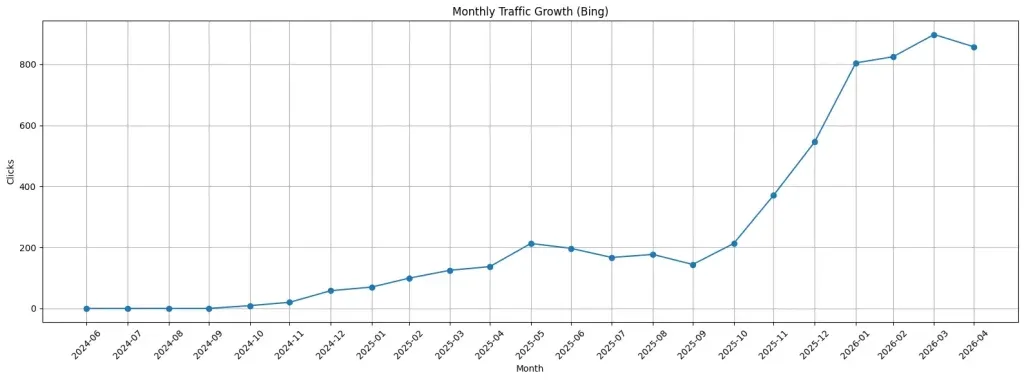
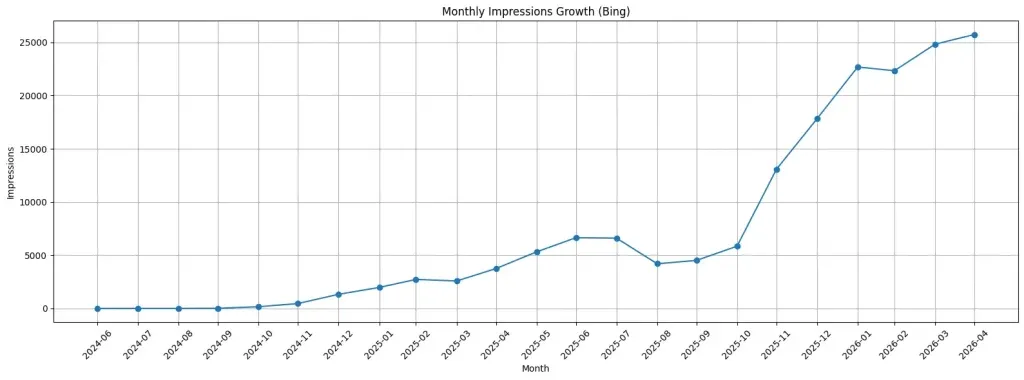
The project started with minimal visibility and negligible traffic. Throughout 2025, steady growth was observed, followed by a strong acceleration phase toward the end of the year and into early 2026.
This pattern reflects a classic SEO momentum effect: once a search engine begins to recognize content quality and domain consistency, visibility increases rapidly. As a result, newly published pages start ranking faster, while existing pages gain stronger positions.
Keyword Analysis (Distribution and Percentages)
The dataset includes a total of 5,198 keywords, providing a clear picture of the domain’s ranking strength:
- Top 3 positions: 2,012 keywords → 38.7%
- Top 10 positions: 5,078 keywords → 97.7%
- Top 20 positions: 5,160 keywords → 99.3%
- Outside Top 20: 38 keywords → 0.7%
Interpretation of Keyword Distribution
This distribution is exceptionally strong and significantly above typical SEO benchmarks.
1. Dominance in Top 10 (97.7%)
Nearly all keywords rank on the first page of search results. This indicates high topical relevance, strong content alignment with search intent, and efficient indexing.
2. Strong Top 3 Presence (38.7%)
Over one-third of all keywords rank in the top 3 positions – the most valuable zone for clicks. This directly explains the sharp increase in traffic, as user behavior heavily favors top results.
3. Minimal Low-Visibility Content (0.7%)
Only a negligible number of keywords fall outside the top 20. This suggests that almost every indexed page contributes to visibility, with very little “dead” content.
The Gap Between Top 3 and Top 10 (Growth Opportunity)
A critical insight lies in the relationship between:
- Top 3 (38.7%)
- Top 10 (97.7%)
This means approximately 59% of keywords rank between positions 4 – 10.
This segment represents the highest growth potential because:
- small ranking improvements (e.g., position 6 → 2)
- can result in disproportionately higher click-through rates (CTR)
In practical terms, the site already has:
- visibility
- relevance
- indexation
but a large portion of content has not yet reached its maximum traffic potential.
Pareto Analysis of Traffic
Page-level analysis shows:
- 212 pages generate ~80% of total traffic
Unlike traditional SEO models – where a small number of pages dominate – this project demonstrates a distributed traffic structure.
Implications:
- traffic is stable and diversified
- reduced dependency on a few high-risk pages
- strong long-tail coverage across many topics
However, it also indicates an opportunity to develop high-impact “hero pages” that could further accelerate growth.
Key Success Factors
Long-tail SEO strategy
Targeting a large number of specific, lower-competition queries enabled faster rankings and scalable visibility.
Broad content coverage
Publishing a high volume of relevant pages allowed the domain to capture a wide range of search intents.
Consistency over time
Regular content production strengthened domain authority and trust signals within Bing.
Compounding SEO momentum
As authority increased, both indexing speed and ranking performance improved, creating a feedback loop that accelerated growth.
Opportunities for Further Growth
1. Converting Top 10 rankings into Top 3
The largest opportunity lies in pushing keywords from positions 4 – 10 into the top 3, where CTR and traffic increase significantly.
2. Optimizing existing content
Updating and expanding current pages can improve relevance, engagement, and ranking performance.
3. Strategic internal linking
Distributing authority through internal links can strengthen key pages and improve their positions.
4. Building content clusters
Organizing content into thematic clusters can enhance topical authority and improve performance on Google.
Bing vs Google Consideration
Strong performance on Bing does not automatically translate to identical results on Google. However, the current structure provides an excellent foundation for expansion.
While Bing rewards structured and relevant long-tail content efficiently, Google typically requires additional authority signals such as backlinks, brand recognition, and E-E-A-T factors.
Conclusion
Limun.com.hr represents a highly effective implementation of a scalable long-tail SEO strategy. Instead of relying on a small number of dominant pages, the project leverages a wide distribution of content and a large volume of ranking keywords.
The result is a stable, resilient traffic model with strong growth potential.
At this stage, the focus should shift from content expansion to performance optimization – maximizing the value of existing rankings and converting high-potential keywords into top-performing assets.
This case study demonstrates that with the right strategy, consistency, and execution, it is possible to build a powerful organic traffic engine capable of sustained and scalable growth.
2. Google
Google SEO Case Study: Exponential Organic Growth Through Data Analysis and Position Optimization
Overview
This case study presents a detailed analysis of organic growth over a 12+ month period, demonstrating how structured SEO, keyword distribution analysis, Pareto optimization, and seasonality awareness can drive significant and sustainable traffic growth.
The project highlights a critical principle in modern SEO: the greatest growth opportunities often lie not in new keywords, but in optimizing existing rankings – especially those positioned just outside the first page.
Initial Situation
At the beginning of 2025, the website had:
- approximately 2,000 monthly impressions
- very low click volume
- a limited number of ranking keywords
- average positions between 30 and 40
The content strategy was focused on long-tail queries, without strong topical authority or internal linking structure.
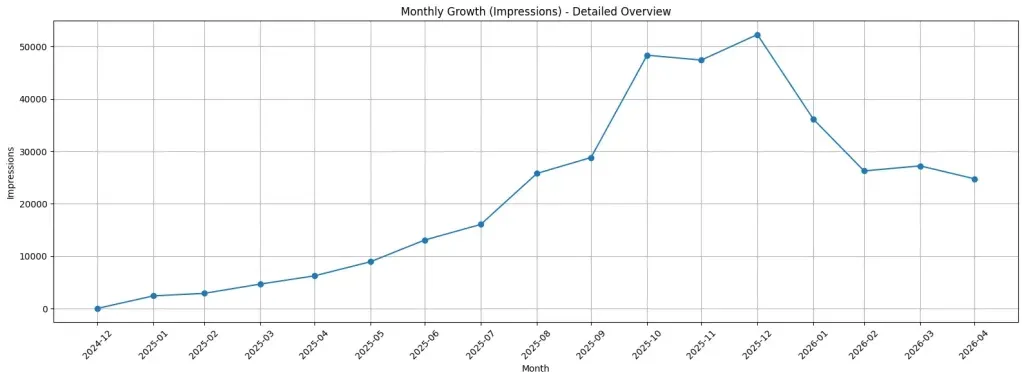
Growth Timeline
Phase 1: Foundation and Indexing (Jan – Jun 2025)
- impressions increased from ~2,000 to ~13,000 per month
- gradual growth in ranking keywords
- average positions improved from 30+ into the 20 – 25 range
During this phase, search engines began testing and indexing content, expanding visibility across long-tail queries.
Phase 2: Acceleration and Expansion (Jul – Sep 2025)
- impressions grew to ~25,000 – 30,000 per month
- significant increase in clicks
- a large number of keywords entered the Top 10
This marks the transition from long-tail visibility to mid-tail keyword rankings, indicating growing domain authority.
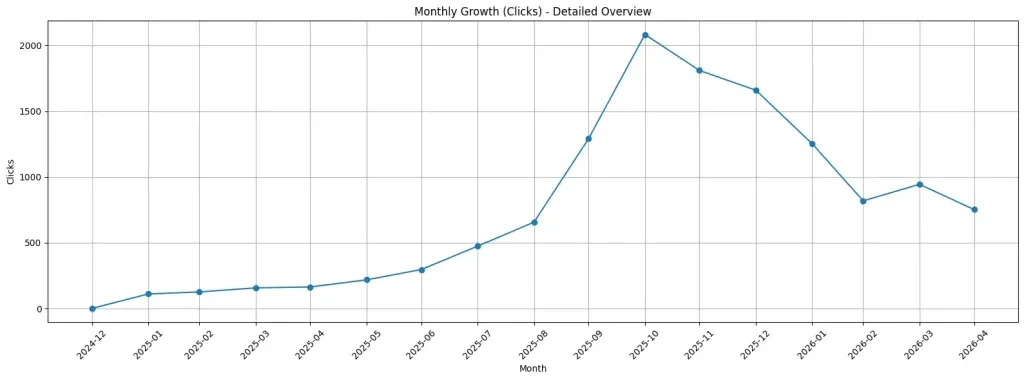
Phase 3: Peak Performance (Oct – Dec 2025)
- impressions exceeded 50,000 per month
- clicks surpassed 2,000 per month
- average positions stabilized around Top 10
This phase represents the cumulative effect of content depth, internal linking, and relevance signals.
Phase 4: Correction and Stabilization (Jan – Apr 2026)
- decline in impressions and clicks
- average positions shifted to the 15 – 17 range
- traffic remained significantly above initial baseline
The decline was driven by:
- search demand seasonality
- increased SERP competition
- redistribution of keyword rankings
There were no indicators of penalties.
Keyword Distribution Analysis
The dataset includes 1,000 keywords:
- Top 3: 25 keywords
- Top 10: 460 keywords
- Top 20: 687 keywords
This distribution indicates:
- strong first-page presence
- a large number of keywords close to high-traffic positions
- significant untapped growth potential
Top Performing Keywords (Core Traffic Drivers)
A detailed analysis of the dataset revealed a concentrated group of high-performing queries responsible for the majority of organic traffic. These queries not only generate the highest number of clicks, but also demonstrate strong click-through rates and stable Top 10 rankings.
Rather than exposing the full keyword set, the data can be best understood through representative examples and thematic patterns.
Representative High-Performing Queries
- high-intent recipe query – 589 clicks, ~54% CTR, avg position ~1.8
- no-cook preparation query – 282 clicks, ~22% CTR, avg position ~4.2
- “how-to” production query – 257 clicks, ~27% CTR, avg position ~3.8
- niche ingredient-based query – 139 clicks, ~21% CTR, avg position ~3.2
- comparison-based informational query – 115 clicks, ~16% CTR, avg position ~2.9
- citrus-based recipe query – 89 clicks, ~55% CTR, avg position ~2.6
These examples illustrate the performance profile without revealing the complete keyword structure.
Key Patterns Behind Performance
Analysis shows that the highest-performing queries consistently fall into several categories:
- Recipe-based long-tail queries
These generate the highest CTR due to clear intent and actionable outcomes. - “How-to” and DIY queries
Strong alignment with user intent results in stable Top 10 rankings and consistent traffic. - Niche ingredient topics
Specific, less competitive queries attract highly targeted audiences. - Informational and comparison queries
While lower in CTR, they contribute additional traffic and broaden topical authority.
Key Insight
A relatively small group of well-targeted long-tail queries drives a disproportionate share of total traffic. This aligns with the Pareto principle observed across the dataset and confirms that precision targeting and intent alignment outperform broad keyword coverage.
This structured approach allows for scalable growth while maintaining a diversified and resilient traffic base – without reliance on a small number of highly competitive keywords.
Key Observations
These keywords reveal several important patterns:
- Recipe-based queries dominate both traffic and CTR performance
- Specific and niche topics (e.g. “picual maslina”) generate highly targeted traffic
- Informational queries (e.g. “značenje”) contribute additional volume but with lower CTR
- High CTR is strongly correlated with Top 3 rankings
This group of keywords forms the core traffic engine of the website and aligns closely with the Pareto analysis, where a small percentage of keywords generates the majority of clicks.
Low-Hanging Fruit Analysis (Positions 11 – 20)
A large number of high-impression keywords are ranking just outside the first page.
Examples include:
- indoktrinacija (~11.6 position, 2,200+ impressions)
- sarkazam značenje (~11.1, 2,100+ impressions)
- kornišoni (~11.0, 1,400+ impressions)
- oportunist (~11.5, 1,400+ impressions)
- kiseljenje feferona (~11.6, 1,300+ impressions)
- dogma značenje (~12.5, 1,100+ impressions)
- trivijalno značenje (~11.7, 1,000+ impressions)
These keywords represent the highest ROI opportunities because:
- they already have visibility
- they are one step away from first-page traffic
- they require minimal optimization to unlock significant gains
Thematic Keyword Clusters
Three dominant clusters emerged:
Informational Queries (Definitions / Meaning)
- sarkazam značenje
- dogma značenje
- trivijalno značenje
- utopija značenje
- antagonist značenje
This cluster indicates strong topical relevance but also highlights opportunities for deeper content expansion.
Food / DIY / Recipes
- kornišoni
- kiseljenje feferona
- rice vinegar
- hot sauces
This is the highest-performing segment in terms of CTR and user intent alignment.
General Educational Queries
- indoktrinacija
- oportunist
- paradoks
These keywords have broad reach and strong search demand.
CTR and User Behavior Analysis
Key findings:
- high CTR (20% – 55%) for top-ranking keywords
- significantly lower CTR for keywords in positions 10 – 15
- multiple keywords with impressions but zero clicks
Conclusion:
CTR plays a critical role in performance differentiation, even when ranking positions are similar.
Pareto Analysis (80/20 Rule)
The analysis shows:
- approximately 106 keywords (10.6%) generate 80% of total clicks
Traffic is concentrated around:
- recipe-based content
- highly specific long-tail queries
- strong intent-driven searches
This confirms that traffic distribution is highly uneven and focused on top-performing content.
Seasonality Analysis
Time-series data reveals:
- strongest growth between September and December
- peak performance in December 2025 and January 2026
- decline in February – April 2026
Conclusion:
- seasonality has a major impact on traffic
- identical rankings can produce different results depending on search demand
Position Trend Analysis
Average positions evolved as follows:
- initial phase: 30 – 40
- growth phase: 10 – 12
- stabilization phase: 15 – 17
The highest traffic was achieved when a large number of keywords ranked within the Top 10.
Key Insights
- SEO growth follows an exponential curve
The most significant results occur after an initial accumulation phase. - The greatest opportunity lies in existing rankings
Keywords between positions 11 – 20 represent the highest-value segment. - Topical authority enhances visibility
Content clustering improves rankings for broader and more competitive queries. - CTR is a key performance driver
Small improvements in titles and snippets can significantly impact traffic. - Seasonality must be accounted for
Traffic fluctuations do not necessarily indicate performance issues.
Conclusion
Within a 12-month period, the website evolved from minimal visibility to a high-performing organic asset, reaching over 50,000 monthly impressions and 2,000+ clicks.
The most important takeaway from this case study is:
The highest value in SEO does not come from new keywords, but from optimizing existing rankings that are close to the first page.
This project demonstrates that data-driven SEO, combined with strategic focus on keyword distribution and user intent, can deliver scalable and sustainable growth without relying on high-risk tactics.